


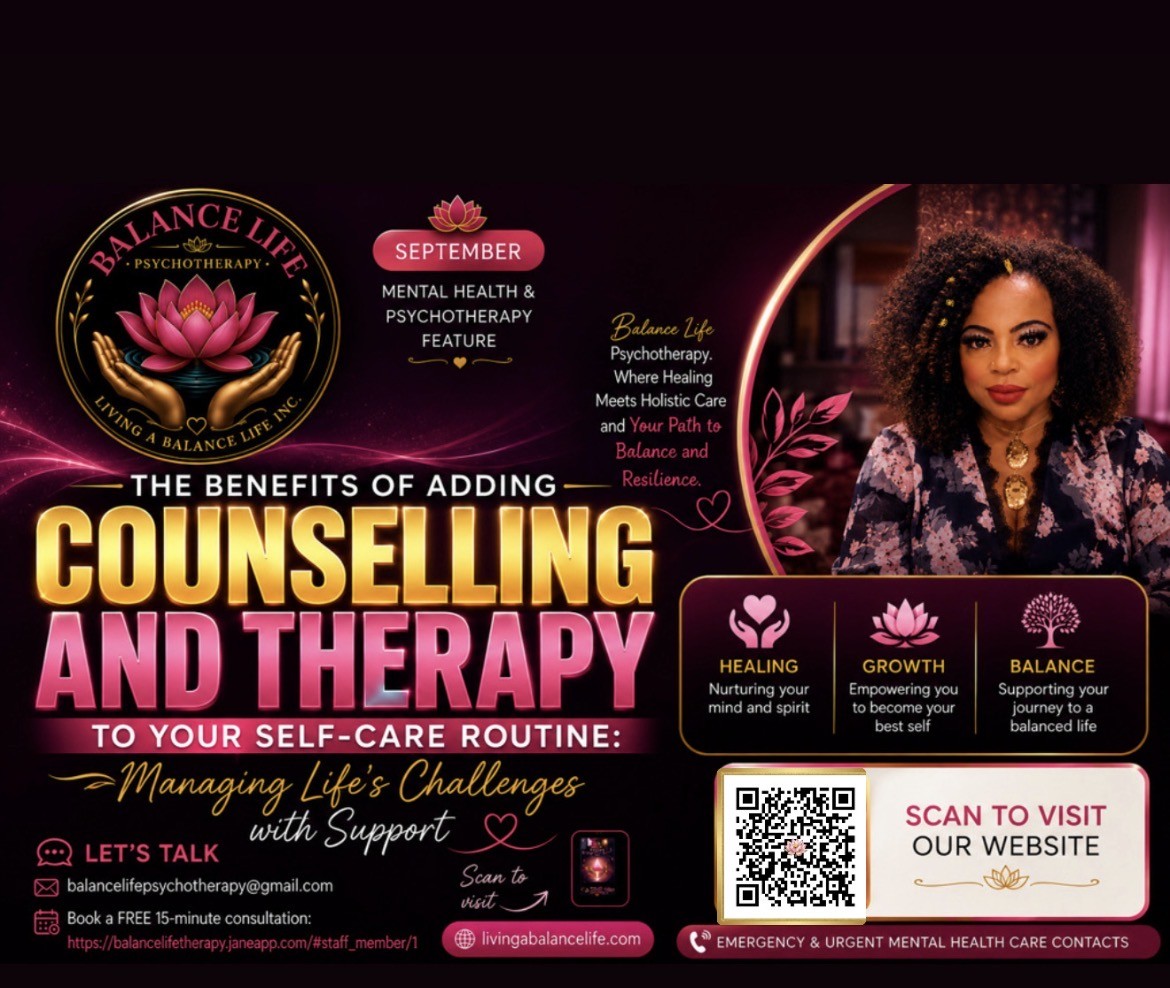
01 Sep The Benefits of Adding Counselling and Therapy to Your Self-Care Routine: Managing Life’s Challenges with Support.
Life can be beautiful, rewarding, and meaningful—but it can also be challenging.
At different stages of life, we may experience relationship difficulties, family responsibilities, workplace stress, financial pressure, parenting challenges, grief, trauma, loneliness, or major life transitions. Sometimes we manage these challenges well. At other times, the emotional weight becomes overwhelming. Many of us have been taught to simply “be strong,” keep going, pray about it, stay busy, or handle our problems privately. While these strategies may provide comfort and strength, there are times when we need more than simply pushing through.
Counselling and psychotherapy can be an important part of self-care, providing a safe space to pause, reflect, heal, and develop healthier ways of managing life’s challenges.
Therapy Is Not Only for When Something Is “Wrong”
One of the biggest misconceptions about counselling is that you have to be experiencing a mental health crisis before seeking support.
You don’t.
Therapy can be preventative, supportive, and growth-oriented. You can seek counselling because you want to understand yourself better, improve your relationships, manage stress, process a difficult experience, strengthen your emotional well-being, or simply have a confidential space where you can talk openly.
Just as we schedule medical appointments, exercise, rest, eat nutritious food, or engage in activities that support our physical health, our emotional and psychological well-being deserve intentional attention too.
Self-care is not simply taking a bubble bath, going on vacation, buying something nice, or taking a day off.
Sometimes, self-care looks like saying:
“I need support, and I am willing to ask for it.”
What Does Therapy Add to Self-Care?
Traditional self-care often focuses on what we do to feel better in the moment. Therapy can help us understand why we feel the way we do, how our experiences have shaped us, and what we can do differently moving forward.
Counselling can become a space for:
- Self-reflection
- Emotional processing
- Problem-solving
- Stress management
- Relationship support
- Building healthy boundaries
- Developing coping strategies
- Improving communication
- Processing grief and loss
- Understanding patterns of behaviour
- Building self-awareness
- Strengthening self-esteem
- Navigating major life transitions
- Healing from difficult experience
Therapy does not eliminate life’s challenges. Instead, it can help us develop the emotional tools and insight needed to navigate those challenges with greater awareness and resilience.
- Therapy Gives You a Safe Space to Talk
Sometimes, we need somewhere to put everything we are carrying.
You may be the person everyone comes to for advice. You may be supporting your children, partner, parents, friends, coworkers, or extended family. You may be the person who appears strong and capable on the outside while privately feeling exhausted.
Counselling provides an opportunity to step out of the caregiver or problem-solver role and focus on yourself.
A therapeutic space allows you to talk about difficult emotions without having to protect everyone else’s feelings. You can explore what you are experiencing, identify what is weighing on you, and begin making sense of your thoughts and emotions.
- Therapy Can Help You Manage Stress Before It Becomes Overwhelming
Stress is a normal part of life. Chronic, unmanaged stress, however, can affect our emotional well-being, relationships, concentration, sleep, motivation, and overall quality of life.
Therapy can help you identify your sources of stress and recognize how stress affects you.
Together with a therapist, you may explore:
- What situations consistently trigger my stress?
- How do I respond when I feel overwhelmed?
- Am I taking on responsibilities that are not mine?
- Do I have healthy boundaries?
- How do I communicate my needs?
- What coping strategies are actually helping me?
- What changes can I realistically make?
The goal is not to create a life without stress. The goal is to develop healthier ways of responding to stress.
- Therapy Helps You Understand Your Emotional Patterns
Have you ever found yourself reacting to a situation and later wondered, “Why did I respond that way?”
Our reactions can sometimes be connected to experiences that occurred long before the current situation.
Past relationships, family dynamics, childhood experiences, trauma, loss, cultural expectations, and significant life events can influence how we interpret situations and respond to others.
Therapy can help you slow down and examine these patterns.
Greater self-awareness can create an important pause between what happens and how we respond.
That pause can give us an opportunity to make a different choice.
- Therapy Can Strengthen Relationships
Healthy relationships require more than love.
They require communication, emotional awareness, boundaries, respect, trust, accountability, and the ability to navigate conflict.
Counselling can help individuals understand their communication styles and relationship patterns. It can also provide tools for expressing needs, setting boundaries, managing conflict, and responding to difficult situations more effectively.
Sometimes the work is about improving the relationship with another person.
Sometimes, it begins with improving the relationship you have with yourself.
- Therapy Can Help You Set Healthier Boundaries
Many people struggle with saying no.
We may worry about disappointing others, appearing selfish, being rejected, or creating conflict.
As a result, we may continuously say yes—even when we are exhausted, overwhelmed, or uncomfortable.
Therapy can help you explore why boundaries may feel difficult and learn how to establish boundaries without unnecessary guilt.
Healthy boundaries are not about shutting people out.
They are about understanding where your responsibilities end and another person’s responsibilities begin.
- Therapy Can Support You Through Life Transitions
Life transitions can be exciting, but they can also be emotionally challenging.
Examples include:
- Starting or leaving a job
- Marriage or separation
- Divorce
- Becoming a parent
- Children leaving home
- Relocation
- Immigration and adjusting to a new environment
- Retirement
- Grief and bereavement
- Changes in family responsibilities
- Career changes
- Starting a new business
- Adjusting to a new stage of life
Even positive changes can create stress.
Therapy can provide support while you adjust to the person you are becoming and the life you are building.
- Therapy Can Help You Process Grief and Loss
Grief does not only occur after the death of someone we love.
We can grieve relationships, friendships, careers, health, dreams, opportunities, familiar environments, or the version of ourselves we once knew.
Sometimes grief is complicated by the expectation that we should “move on.”
But healing does not always mean forgetting.
Therapy can provide a safe environment to acknowledge loss, process emotions, and find ways to move forward while honouring what has been lost.
- Therapy Can Be Particularly Important for People Who Are Used to Being “Strong”
There are people who have spent years being the strong one.
They take care of everyone.
They solve problems.
They provide financially.
They support their families.
They show up when others need them.
But being strong does not mean you never need support.
Strong people need support too.
Seeking counselling is not a sign of weakness. It can actually be an expression of self-awareness and courage.
You do not have to wait until you completely break down before you give yourself permission to receive support.
- Culturally Responsive Therapy Matters
Mental health does not exist separately from culture.
Our cultural background can influence how we understand family, relationships, responsibility, spirituality, success, parenting, gender roles, community, and emotional expression.
For some people, seeking therapy may still carry stigma.
Some individuals may have grown up hearing messages such as:
- “What happens in the family stays in the family.”
- “You don’t tell strangers your business.”
- “Pray about it.”
- “Other people have it worse.”
- “You need to be strong.”
- “Therapy is for people who are crazy.”
These beliefs can make it difficult to reach out for professional support.
Culturally responsive counselling recognizes that a person’s cultural experiences matter. It creates space to explore mental health within the context of the individual’s identity, family, community, values, and lived experiences.
You should not have to leave your culture at the door to receive mental health support.
- Therapy Can Help You Move From Surviving to Intentionally Living
Sometimes we become so focused on getting through the next day that we stop asking ourselves what we actually want from life.
Therapy can create space for deeper questions:
Who am I?
What do I need?
What matters to me?
What kind of relationships do I want?
What boundaries do I need?
What am I ready to let go of?
What kind of life am I trying to build?
Self-care is not simply about recovering from exhaustion.
It is also about creating a life that is aligned with your values, needs, goals, and well-being.
You Don’t Have to Wait for a Crisis
One of the most important messages I want to share this September is this:
You don’t have to be in crisis to deserve support.
You can seek therapy when things are relatively stable.
You can seek therapy because you want to grow.
You can seek therapy because you are entering a new chapter.
You can seek therapy because you want to understand yourself better.
You can seek therapy because you are tired of repeating the same patterns.
You can seek therapy because you want healthier relationships.
You can seek therapy because you have been carrying something for a long time and are finally ready to put it down.
And you can seek therapy simply because your emotional well-being matters.
Making Therapy Part of Your Self-Care Plan
If counselling is something you have been considering, start by thinking about what you need.
Ask yourself:
- What am I currently struggling with?
- What emotions have I been experiencing most often?
- What patterns would I like to change?
- What area of my life needs more attention?
- What would I like to understand about myself?
- What kind of support would feel helpful and culturally appropriate for me?
You don’t need to have all the answers before beginning therapy. That is part of what therapy is for.
Support for Your Mental Health Journey
At Balance Life Psychotherapy, we provide culturally tailored mental health services designed to meet your unique needs and lived experiences. Our approach is spiritually grounded, holistic, and client-centered, supporting you as you heal, grow, and work toward living a more balanced and fulfilling life.
We draw from multiple therapeutic modalities to support you with the challenges you may be facing. Our goal is to address not only your mental health needs, but also the emotional, relational, social, and personal factors that influence your overall well-being and quality of life.
Let’s TALK
You do not have to navigate life’s challenges alone. If you are considering counselling or psychotherapy, we invite you to take the first step and connect with us.
Email: balancelifepsychotherapy@gmail.com
Book a Free 15-Minute Consultation:
https://balancelifetherapy.janeapp.com/#staff_member/1
Balance Life Psychotherapy — Where Healing Meets Holistic Care, and Your Path to Balance and Resilience Begins.
Emergency & Urgent Mental Health Care
If you are experiencing a mental health emergency or are concerned about your immediate safety, please seek urgent professional help, text or call 988 hotline across Canada.
Life will continue to bring challenges. We cannot control everything that happens to us, but we can develop healthier ways of responding, coping, healing, and moving forward.
Adding counselling or psychotherapy to your self-care routine can be an investment in your emotional health, relationships, personal growth, and overall quality of life.
Taking care of yourself is not selfish.
Asking for help is not weakness.
Therapy is not a failure to cope.
Sometimes, therapy is simply a decision to stop carrying everything alone.
This September, consider making your mental health part of your self-care plan.
Give yourself permission to pause.
Give yourself permission to reflect.
Give yourself permission to heal.
And most importantly, give yourself permission to receive support.
Living A Balance Life — because your mental health, healing, and well-being matter.
Sorry, the comment form is closed at this time.