


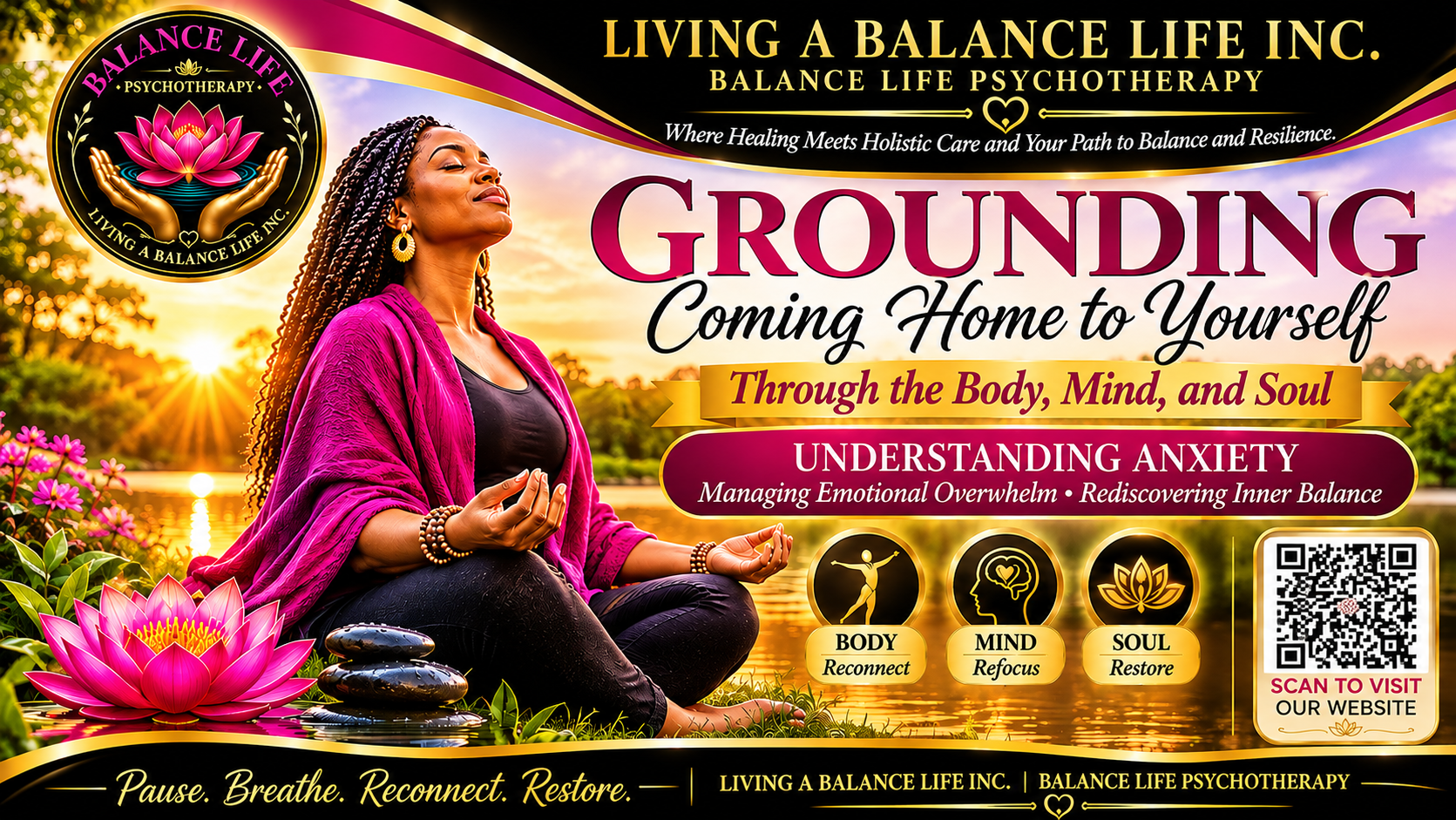
09 Nov GROUNDING: COMING HOME TO YOURSELF THROUGH THE BODY, MIND, AND SOUL.
Understanding Anxiety, Managing Emotional Overwhelm, and Rediscovering Inner Balance. Where Healing Meets Holistic Care and Your Path to Balance and Resilience.
When Life Becomes Overwhelming
Have you ever experienced a moment when everything feels like too much? Your mind is racing, your emotions are heightened, your body feels tense, and even the simplest responsibilities become exhausting.
Perhaps you are navigating difficult relationships, family responsibilities, financial pressures, workplace stress, grief, uncertainty, illness, or major life transitions. You may find yourself constantly thinking about what has happened, worrying about what might happen next, or trying to manage situations beyond your control.
Sometimes, you become so consumed by the demands of everyday life that you lose connection with yourself.
You continue showing up for others, fulfilling responsibilities, solving problems, and trying to keep everything together. Yet, somewhere along the way, you forget to check in with the person who needs your attention the most: YOU.
This is where grounding becomes important.
Grounding is a practice that helps you reconnect with the present moment, your physical body, your thoughts, your emotions, and your surroundings. It can help you manage overwhelming feelings, develop emotional awareness, and create opportunities for calm and self-reflection.
Grounding does not mean pretending everything is okay. It does not mean suppressing your emotions, ignoring your struggles, or forcing yourself to remain positive.
Rather, it means acknowledging what you are experiencing while gently bringing your attention back to the present.
Grounding is an invitation to come home to yourself.
-
Understanding Anxiety and Emotional Overwhelm
Anxiety is a natural human response to perceived danger, uncertainty, stress, or anticipated challenges. It can prepare us to respond to difficult situations. However, when anxiety becomes persistent or overwhelming, it can affect our physical health, emotional well-being, relationships, decision-making, and daily functioning.
Emotional overwhelm occurs when the intensity or accumulation of our emotional experiences exceeds our perceived ability to manage them at that moment.
It can happen when several responsibilities, expectations, disappointments, and life challenges accumulate without sufficient time or support to process them.
You may experience:
- Racing thoughts and excessive worrying.
- Difficulty concentrating or making decisions.
- Irritability, frustration, or emotional sensitivity.
- Muscle tension, headaches, or physical discomfort.
- Rapid heartbeat or changes in breathing.
- Difficulty sleeping or persistent fatigue.
- Feeling disconnected, restless, or emotionally exhausted.
- Wanting to withdraw from people and responsibilities.
Sometimes, you may not even understand why you feel overwhelmed. You simply recognize that something does not feel right.
It is important to remember that emotional distress is not a personal failure. It is an experience that deserves attention, understanding, and appropriate care.
Rather than judging yourself for how you feel, begin by asking:
What might my body, mind, and emotions be communicating to me right now?
-
Grounding Through the Body: Reconnecting With Yourself
Our bodies often communicate stress before we consciously recognize what is happening emotionally.
When we experience anxiety, our nervous system may activate the body’s stress response. Breathing can become faster, muscles may tighten, the heart may beat more rapidly, and the body may become more alert.
Learning to recognize these physical responses is an important part of emotional wellness.
Grounding through the body involves bringing gentle awareness to physical sensations and engaging in activities that help us feel present and settled.
Practical ways to ground your body
- Feel your feet on the ground: Sit comfortably or stand with both feet touching the floor. Notice the pressure beneath your feet. Gently press your toes into the ground and become aware of the support beneath you.
- Practise mindful breathing: Take a gentle breath through your nose and slowly release it through your mouth. Allow your breathing to become comfortable and natural.
- Release physical tension: Notice whether you are holding tension in your shoulders, neck, jaw, hands, or abdomen. Gently relax these areas.
- Engage in mindful movement: Take a walk, stretch, dance, or participate in gentle physical activity. Pay attention to how your body moves.
- Prioritize rest and nourishment: Sleep, hydration, balanced nutrition, movement, and appropriate medical care all contribute to physical and emotional well-being.
Your body is not simply something that carries you through your responsibilities. It deserves care, attention, and compassion.
Remember: Learn to listen to your body before exhaustion forces you to stop.

-
Grounding Through the Mind: Managing Your Thoughts and Emotions
The mind can become an overwhelming place when we are constantly replaying past experiences, anticipating future problems, or imagining the worst possible outcomes.
Anxiety often takes us away from the present moment.
We may spend hours worrying about conversations that have already happened, decisions we cannot change, or circumstances that have not yet occurred.
Grounding through the mind involves learning to recognize thoughts, acknowledge emotions, and redirect attention towards what is happening in the present.
The 5-4-3-2-1 grounding technique
This sensory grounding exercise helps redirect your attention to your immediate surroundings.
- 5 things you can see: Look around and identify five objects.
- 4 things you can feel: Notice your feet on the floor, your clothing, or your hands touching a surface.
- 3 things you can hear: Identify three sounds around you.
- 2 things you can smell: Notice two scents.
- 1 thing you can taste: Pay attention to the taste in your mouth or take a sip of water.
This exercise encourages you to engage with your surroundings rather than becoming completely absorbed in overwhelming thoughts.
Challenge your thoughts
Not every thought represents reality. Sometimes, anxiety causes us to interpret uncertainty as danger or possibility as certainty.
When you notice overwhelming thoughts, ask yourself:
- What am I afraid might happen?
- Do I have evidence that this will happen?
- Am I focusing on what I can control or what I cannot control?
- What would I say to someone I love experiencing this situation?
- What is one manageable step I can take right now?
Practise emotional acceptance
You do not have to fight every emotion.
You can acknowledge sadness without judging yourself. You can experience frustration without reacting impulsively. You can feel anxious while still making thoughtful decisions.
Emotional regulation is not about never becoming upset. It is about developing the ability to recognize, understand, and respond to emotions in healthier ways.
Remember: You are allowed to experience difficult emotions without allowing those emotions to define your entire identity or determine every decision you make.
-
Grounding Through the Soul: Reconnecting With Your Inner Peace
Our well-being extends beyond our physical and psychological experiences. Many people also find meaning, comfort, strength, and hope through spirituality, faith, personal values, purpose, and connection.
Grounding through the soul is about creating opportunities to reconnect with what gives your life meaning.
For some people, this may involve prayer, scripture, meditation, gratitude, spending time in nature, or quiet reflection. For others, it may involve connecting with loved ones, engaging in meaningful activities, or rediscovering their sense of purpose.
There is no single approach that works for everyone.
Ways to nurture your spiritual and inner well-being
- Spend quiet moments in prayer or reflection.
- Practise gratitude while allowing yourself to acknowledge difficult experiences.
- Connect with nature and appreciate the present moment.
- Reflect on your values and what matters most to you.
- Release the pressure to control everything.
- Seek meaningful relationships and supportive communities.
- Make room for forgiveness, self-compassion, and personal growth.
Sometimes, we become so focused on what we have lost, what has disappointed us, and what has not worked out that we forget to acknowledge the strength that has carried us through difficult seasons.
Spiritual grounding can provide an opportunity to reconnect with hope, meaning, and resilience.
Remember: You do not need to have all the answers to find moments of peace. Sometimes, peace begins with accepting that you are human, that life has uncertainties, and that you deserve compassion along the way.
-
The Connection Between the Body, Mind, and Soul
Holistic wellness recognizes that our physical, psychological, emotional, social, and spiritual experiences are interconnected.
Stress affecting the mind can influence the body. Physical exhaustion can affect emotional regulation. Emotional distress can influence relationships, motivation, and our sense of meaning.
For example, someone experiencing prolonged stress may have difficulty sleeping. Poor sleep may contribute to irritability, fatigue, and difficulty concentrating. These challenges may then increase feelings of anxiety and emotional overwhelm.
This demonstrates why caring for one aspect of our well-being while neglecting the others may leave us feeling incomplete.
Consider the following questions:
BODY
- Am I getting enough rest?
- Am I nourishing my body?
- Am I carrying physical tension?
- Am I listening to my body’s needs?
MIND
- What thoughts are consuming me?
- What emotions need attention?
- What can I release?
- Am I being kind to myself?
SOUL
- What gives my life meaning?
- What helps me reconnect?
- What gives me hope?
- Am I making room for reflection?
The goal is not to achieve perfect balance every day. It is to develop awareness of what needs attention and make intentional choices that support your overall well-being.

-
The Importance of Boundaries, Self-Love, and Giving Yourself Grace
One of the reasons people become emotionally overwhelmed is that they continually give to others without creating adequate space for their own needs.
You may feel responsible for everyone’s happiness, constantly available to family and friends, or pressured to meet expectations that leave little room for personal restoration.
You may also struggle to say no because you fear disappointing others.
However, healthy boundaries are an important part of emotional wellness.
Boundaries help us recognize what we can reasonably give, what we need to protect, and what we cannot control.
Self-love is not selfishness. It is recognizing that your needs, feelings, health, and well-being matter too.
Practising self-love may mean:
- Saying no without excessive guilt.
- Recognizing when you need a break.
- Asking for help when responsibilities become overwhelming.
- Stepping away from unhealthy situations when possible.
- Releasing unrealistic expectations.
- Accepting that you cannot please everyone.
- Allowing yourself to grow without constantly criticizing yourself.
Giving yourself grace means recognizing that you are a human being who will experience difficult days, make mistakes, experience disappointment, and sometimes need to begin again.
You do not have to earn the right to rest. You do not have to prove your worth through constant productivity.
You deserve the same compassion you so freely extend to others.
-
Creating Grounding and Self-Care Practicee a Persona
Grounding becomes more meaningful when it is incorporated into everyday life.
Rather than waiting until anxiety becomes overwhelming, consider developing small daily practices that help you remain connected to yourself.
Morning: Begin with intention
- Take a few moments before checking your phone.
- Breathe gently and stretch.
- Reflect on how you are feeling.
- Identify one realistic intention for the day.
- Express gratitude for a new opportunity to begin again.
During the day: Check in with yourself
- Notice your breathing and physical tension.
- Take short breaks between responsibilities.
- Drink water and nourish your body.
- Practise saying no when necessary.
- Pause when you notice yourself becoming overwhelmed.
Evening: Release and restore
- Reflect on the day’s experiences.
- Acknowledge what went well.
- Identify what was difficult without judging yourself.
- Release the pressure to solve tomorrow’s problems tonight.
- Engage in prayer, meditation, reading, or another calming activity.
- Prioritize restorative sleep.
Consistency matters more than perfection. Even a few intentional minutes can create an opportunity to reconnect with your needs.

-
A Moment to Pause: Your Two-Minute Grounding Exercise
When life feels overwhelming, try this simple exercise.
Step 1: PAUSE
Stop what you are doing, if possible. Give yourself permission to take a moment.
Step 2: BREATHE
Take three slow, comfortable breaths. Allow your body to settle naturally.
Step 3: CONNECT
Feel your feet touching the floor. Notice your surroundings and the physical sensations in your body.
Step 4: ACKNOWLEDGE
Ask yourself: What am I feeling right now? What do I need in this moment?
Step 5: REASSURE
Say these words to yourself:
- I am allowed to pause.
- I do not have to solve everything today.
- My feelings deserve compassion.
- I can take one step at a time.
- I am learning to care for myself.
- I give myself permission to begin again.
-
Reflection Questions: Coming Home to Yourself
Take a few moments to reflect honestly.
- What is currently taking up the most emotional space in my life?
- How is stress affecting my body?
- What thoughts or worries am I finding difficult to release?
- Am I giving myself the same care and attention I give to others?
- What boundaries do I need to establish or strengthen?
- What activities help me feel grounded, peaceful, and connected?
- What does my body need today?
- What does my mind need today?
- What does my soul need today?
- What is one small change I can make to nurture my well-being?
You do not need to answer every question immediately. Allow yourself time to reflect.
-
When Grounding Is Not Enough: Recognizing When to Seek Support
Grounding is a helpful coping strategy, but it is not a replacement for professional mental health support.
If anxiety is persistent, intensifying, interfering with relationships, affecting sleep, or making it difficult to function in everyday life, consider speaking with a qualified mental health professional or healthcare provider.
Therapeutic approaches such as cognitive behavioural therapy, mindfulness-based interventions, and other evidence-informed treatments may help individuals understand and manage anxiety.
It is also important to recognize that trauma, grief, chronic illness, financial stress, discrimination, and difficult life circumstances may contribute to emotional distress.
Seeking help is not a sign of weakness. It is an act of self-awareness and self-care.
Sometimes, healing requires more than individual coping strategies. It may require supportive relationships, professional intervention, and access to appropriate resources.
-
Finding Support: You Do Not Have to Navigate Life Alone
Sometimes, despite our best efforts to practise grounding, self-care, and emotional regulation, we may continue to experience anxiety, emotional distress, unresolved trauma, grief, relationship difficulties, or other mental health challenges.
There is no shame in seeking professional support.
Healing is not always a journey we have to navigate alone. Working with a mental health professional can provide a safe, supportive, and non-judgmental space to explore your experiences, understand emotional patterns, develop healthier coping strategies, and work towards meaningful change.
At Balance Life Psychotherapy, we recognize that every individual has a unique story, lived experience, cultural identity, and set of circumstances.
We provide culturally tailored mental health services designed to meet your unique needs. Our approach is spiritually grounded, holistic, and client-centered, supporting you in healing, growing, and living a more balanced life.
We recognize that mental health is influenced by many aspects of life, including culture, family, relationships, spirituality, physical health, social circumstances, and personal experiences.
We use multiple therapeutic modalities to address whatever you may be facing, helping to improve not only your mental health but also your overall well-being and quality of life.
Whether you are navigating anxiety, stress, emotional overwhelm, grief, trauma, life transitions, relationship challenges, or difficulties reconnecting with yourself, we are here to support your journey.
Our goal is to help you develop greater self-awareness, strengthen emotional resilience, discover healthier ways of coping, and reconnect with the person you are becoming.
You deserve to be heard. You deserve to be understood. You deserve care that recognizes the whole person.
-
A Final Reminder: Give Yourself Permission to Begin Again
Life will not always unfold according to our expectations. There will be seasons of uncertainty, disappointment, change, loss, and unexpected challenges.
There will also be seasons of growth, healing, discovery, renewed hope, and new beginnings.
Through all these experiences, remember that your well-being matters.
You do not have to have everything figured out. You do not have to carry every burden alone. You do not have to be strong every single day.
Sometimes, finding balance does not mean changing everything around you. Sometimes, it begins with changing how you respond to yourself.
Give yourself permission to pause. Listen to your body. Be mindful of your thoughts. Nourish your soul. Establish healthy boundaries. Seek support when needed.
Most importantly, remember that healing is a process, not a destination.
Come back to yourself. Reconnect with your needs. Give yourself grace. Choose healing, one moment at a time.
YOUR BODY DESERVES CARE. YOUR MIND DESERVES PEACE. YOUR SOUL DESERVES NOURISHMENT.
PAUSE. BREATHE. RECONNECT. RESTORE.
 LET’S TALK – BALANCE LIFE PSYCHOTHERAPY
You do not have to wait until you reach your breaking point before seeking support. Taking the first step towards your mental health and well-being is an act of courage and self-care.
At Balance Life Psychotherapy, we provide culturally tailored mental health services designed to meet your unique needs. Our approach is spiritually grounded, holistic, and client-centered, supporting you in healing, growing, and living a more balanced life.
We use multiple therapeutic modalities to address whatever you may be facing, helping to improve not only your mental health but your overall well-being and quality of life.
Connect with us:
Email: balancelifepsychotherapy@gmail.com
Book a free 15-minute consultation:
Book your free 15-minute consultation
BALANCE LIFE PSYCHOTHERAPY
Where Healing Meets Holistic Care and Your Path to Balance and Resilience.
BODY • MIND • SOUL
Come as you are. Your healing journey matters.
Disclaimer: This article is intended for general mental health and wellness education. It does not replace professional mental health assessment, diagnosis, treatment, or medical advice. Grounding exercises are supportive coping strategies and may not be appropriate for everyone. If an exercise increases distress, stop and consider an alternative approach. If you are experiencing persistent or severe emotional distress, seek support from a qualified healthcare professional.
No Comments