


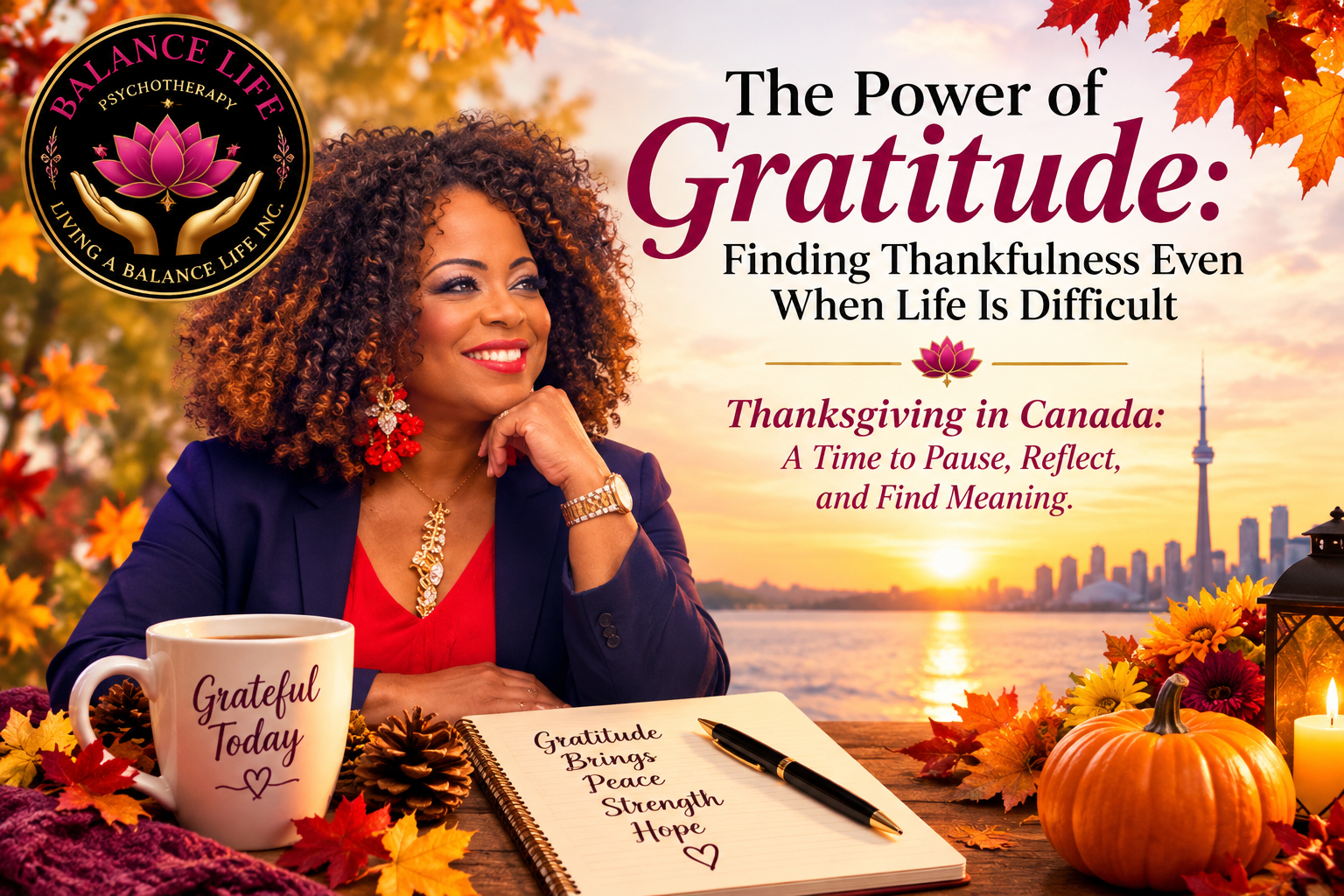
08 Oct The Power of Gratitude: Finding Thankfulness Even When Life Is Difficult. Thanksgiving in Canada: A Time to Pause, Reflect, and Find Meaning
October is Thanksgiving month in Canada—a time when many people gather with family and friends, share meals, reflect on their blessings, and express appreciation for the people and experiences that matter to them.
But Thanksgiving can also bring complicated emotions.
For some, this season may highlight the absence of a loved one, relationship difficulties, financial stress, health concerns, loneliness, family conflict, immigration or settlement challenges, or uncertainty about the future. While others are celebrating, you may be struggling to simply get through the day.
And that is okay.
Gratitude does not mean pretending that everything is okay.
It does not require us to ignore our pain, minimize our experiences, or force ourselves to be positive when life feels overwhelming.
Instead, gratitude can be a gentle practice of noticing what is still meaningful—even in the middle of life’s challenges.
What Is Gratitude?
Gratitude is the intentional practice of recognizing and appreciating the people, experiences, opportunities, strengths, or small moments that bring meaning to our lives.
Sometimes gratitude is about something significant: a supportive family member, a meaningful career, a safe home, or a new opportunity.
Other times, gratitude can be much smaller:
A warm cup of tea.
A peaceful morning.
A phone call from someone you love.
A good night’s sleep.
A beautiful sunset.
Having the strength to get out of bed on a difficult day.
Someone listening when you needed to talk.
Gratitude can exist alongside hardship.
You can be grateful and still be tired.
You can be grateful and still be grieving.
You can be grateful and still experience anxiety.
You can appreciate your life while recognizing that there are things you desperately want to change.
There is room for both.
Gratitude Is Not Toxic Positivity
There is an important difference between gratitude and toxic positivity.
Toxic positivity can sound like:
“Just be grateful.”
“Look at the bright side.”
“Other people have it worse.”
“Everything happens for a reason.”
Although these statements may sometimes be well-intentioned, they can unintentionally dismiss someone’s pain.
A healthier approach is to acknowledge the full picture:
“This is difficult, and there are still things I can appreciate.”
That small shift can make gratitude feel more authentic and compassionate.
You don’t have to deny what hurts in order to recognize what helps.
The Mental Health Benefits of Practicing Gratitude
Gratitude is not a replacement for professional mental health care, and it should never be used to suggest that someone can simply “think” their way out of depression, anxiety, trauma, grief, or other mental-health concerns.
However, cultivating gratitude can become one part of a broader approach to emotional wellness.
A regular gratitude practice may help people:
- Become more aware of positive experiences and meaningful moments
- Shift attention away from constant negative thinking
- Develop greater emotional awareness
- Strengthen relationships through appreciation and acknowledgment
- Increase feelings of connection and belonging
- Develop a greater appreciation for personal strengths and resilience
- Create moments of calm and reflection during stressful periods
- Support a more balanced perspective during challenging seasons
The goal isn’t to eliminate difficult emotions.
The goal is to create space for positive emotions alongside difficult ones.
Gratitude During Difficult Seasons
Sometimes the most meaningful gratitude is found during seasons when life doesn’t look the way we expected.
Perhaps you are experiencing a separation or divorce.
Perhaps you are adjusting to a new country.
Perhaps your children are growing up and your family dynamic is changing.
Perhaps you are caring for an aging parent.
Perhaps you are navigating chronic illness.
Perhaps you are rebuilding your life after loss.
Perhaps you are successful professionally but feel emotionally exhausted.
Perhaps everyone around you seems happy, while internally you are struggling.
During these seasons, gratitude may need to look different.
Instead of asking:
“What is good about my life?”
Try asking:
“What is helping me get through this season?”
Maybe it is your resilience.
Maybe it is one supportive friend.
Maybe it is your faith.
Maybe it is your therapist.
Maybe it is your ability to keep going.
Maybe it is the fact that you are learning to set boundaries.
Maybe it is simply waking up today and choosing to try again.
Those things matter.
Five Simple Ways to Practice Gratitude This Thanksgiving
- Keep a Gratitude Journal
At the end of the day, write down three things you appreciated.
They don’t have to be extraordinary.
Try:
Today I am grateful for…
- Someone who checked on me.
- A peaceful moment.
- Something my body allowed me to do.
- A lesson I learned.
- A meal I enjoyed.
- A moment that made me smile.
Over time, this practice can help you become more intentional about noticing meaningful experiences.
- Tell Someone You Appreciate Them
Sometimes we feel gratitude but never express it.
This Thanksgiving, consider telling someone:
“I appreciate you.”
Tell a friend what their friendship means to you.
Thank a family member.
Send a message to someone who supported you during a difficult season.
Gratitude can strengthen connection.
- Practice Gratitude for Yourself
We often thank everyone else and forget to acknowledge ourselves.
Take a moment to recognize your own strength.
You might say:
“I am proud of myself for…”
Maybe you kept going.
Maybe you asked for help.
Maybe you established a boundary.
Maybe you started therapy.
Maybe you survived something you never thought you could.
Self-compassion is an important part of emotional wellness.
- Practice Mindful Gratitude
Slow down.
Take a breath.
Notice where you are.
Look around you.
What can you see?
What can you hear?
What can you feel?
What is one thing in this moment that you can appreciate?
Gratitude does not always require a journal. Sometimes it simply requires us to pause long enough to notice.
- Make Room for Every Emotion
This Thanksgiving, give yourself permission to experience the full range of your emotions.
You can laugh and cry.
You can celebrate and grieve.
You can feel hopeful and uncertain.
You can be thankful and still want things to change.
You do not have to choose between gratitude and honesty.
Both can exist.
Gratitude and Resilience
Resilience does not mean that life never hurts.
Resilience means developing the capacity to move through difficult experiences while continuing to care for yourself, seek support, adapt, learn, and grow.
Gratitude can become one small part of that process.
When life feels overwhelming, gratitude can help us pause and remember:
“This difficult moment is part of my story, but it does not have to be the entirety of my story.”
There may still be possibilities ahead.
There may still be people who care.
There may still be healing available.
There may still be reasons to hope.
If Thanksgiving Feels Difficult, You Are Not Alone
For some people, Thanksgiving is not a joyful season.
It may bring loneliness, grief, family tension, painful memories, financial pressure, or increased awareness of what feels missing.
If that is your experience, you do not have to force yourself to feel grateful.
Instead, consider giving yourself permission to acknowledge what you are experiencing.
Your feelings are worthy of being heard.
Sometimes healing begins when we stop judging ourselves for how we feel and begin understanding what those feelings are trying to tell us.
Finding Balance Through Gratitude
At Balance Life Psychotherapy, we believe mental wellness is not about creating a life without challenges.
It is about developing the tools, insight, support, and resilience to navigate life’s challenges in healthier and more meaningful ways.
Our approach recognizes the whole person—mind, body, emotions, relationships, culture, spirituality, and lived experiences.
At Balance Life Psychotherapy, we provide culturally tailored mental health services designed to meet your unique needs. Our approach is spiritually grounded, holistic, and client-centered, supporting you in healing, growing, and living a more balanced life.
We use multiple therapeutic modalities to address whatever you may be facing, helping to improve not only your mental health, but also your overall well-being and quality of life.
This Thanksgiving, Give Yourself Permission to Pause
You don’t need to have everything figured out.
You don’t need to be happy all the time.
You don’t need to minimize your struggles to appreciate your blessings.
Take a breath.
Acknowledge where you are.
Honor what you have survived.
Appreciate what is meaningful.
Reach out for support when you need it.
And remember:
Gratitude is not about pretending life is perfect.
It is about learning to notice the light—even when life has difficult shadows.
Let’s TALK
If you are experiencing anxiety, stress, grief, relationship challenges, life transitions, emotional exhaustion, or simply feel that you need someone to talk to, professional support can make a difference.
At Balance Life Psychotherapy, we are here to walk alongside you with compassionate, culturally responsive, holistic, and client-centered care.
Where Healing Meets Holistic Care and Your Path to Balance and Resilience.
Email: balancelifepsychotherapy@gmail.com
Book your FREE 15-minute consultation:
https://balancelifetherapy.janeapp.com/#staff_member/1
Learn more about our services:
https://livingabalancelife.com
Please note: This article is for educational purposes and is not a substitute for professional mental-health assessment, diagnosis, or treatment. If you are experiencing a mental-health crisis or are in immediate danger, please contact emergency services or an appropriate crisis service in your area. In Canada, 988.
Sorry, the comment form is closed at this time.